Our modern manufacturing has gone through significant improvements since the invention of CNC lathes. It contributes superior efficiency and consistency to the machining process, providing high-quality outputs even under mass production. The concept of the CNC lathe was first introduced in the mid-20th century. Over the decades of progression, CNC lathes are widely used in various industries, including automotive, electronics, and aerospace manufacturing.
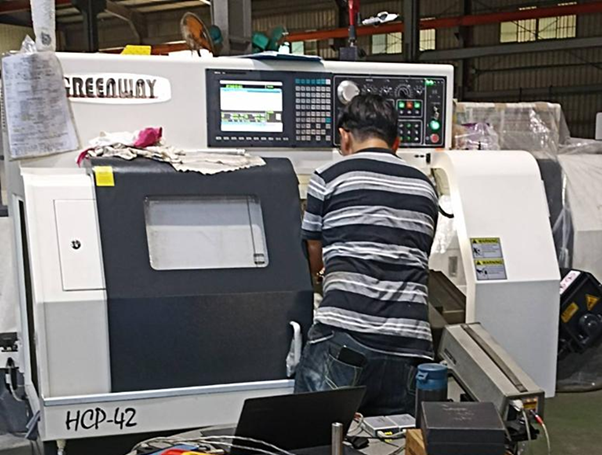
While there are multiple types of CNC lathes available nowadays, the horizontal CNC lathe remains the preferred choice for many manufacturers. In this insightful guide, we will explore what a horizontal CNC lathe is, discuss its main categories, and share a representative example. Moreover, we will introduce some of Greenway's highly recommended lathes to help you make a great choice.
Before getting into the world of horizontal CNC lathe, we will go through a brief introduction to CNC lathe. It is an advanced machine tool that integrates CNC (Computer Numerical Control) technology. Most machining processes operate automatically by following the programmed path.
The horizontal CNC lathe is one of the CNC lathe types. The workpiece is clamped and rotates on a horizontal axis against the cutting tools while machining. Due to the support of the horizontal configuration, this type of CNC lathe is ideal for machining long and heavy workpieces, making it suitable for industries that require substantial production capacity. Additionally, it allows the chips to fall out of the workpiece naturally during the machining process, which prevents chips from accumulating and improves overall efficiency. This pioneering machine is widely applied in machining from automotive engine components to aircraft gears.
The horizontal CNC lathe is often categorized by its tooling systems, axis setups, and spindle configurations. However, these elements can be flexibly combined based on the machining requirements. Due to the versatility of the machine structure and capabilities, the horizontal CNC lathe is better understood as configurable systems rather than fixed types.
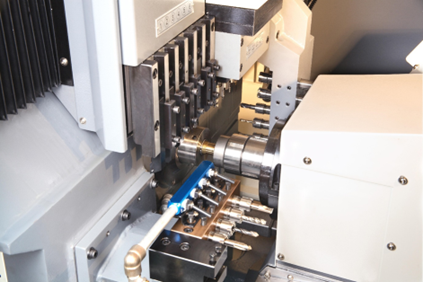
For instance, the turret-type CNC lathe is a popular model in the market. It may adopt a turret-type tooling system, which is compatible with a basic 2-axis configuration or a 3-axis configuration for multi-directional machining. As a result, terms like “turret-type” or “gang-type” represent specific setups, instead of distinct categories. This principle also applies to other aspects, such as axis counts and spindle configurations. By understanding the relationships between the setups, we can better interpret model names and prevent confusion with the various lathe models in the market. In the following sections, we will take a closer look at each configuration to figure out its functions, features, and applications.
The tooling system is one of the key configurations in the CNC lathe setup. It holds a set of cutting tools, enabling the machine to operate turning, milling, and drilling.
Turret type
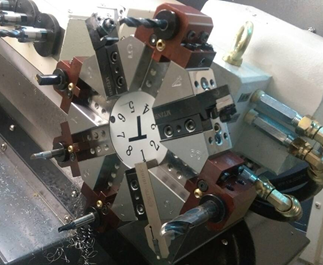
The turret holds multiple cutting tools in a rotating toolholder. It usually supports 8 to 12 tools, which enables flexible and efficient tool changes during the machining process. The turret automatically indexes to position the appropriate tool when a different operation is required. This capability greatly enhances machining efficiency, minimizes downtime, and reduces manual costs. Due to these advantages, the turret-type tooling system is suitable for use in industries that require rigidity and stability, such as automotive and aerospace.
Gang type
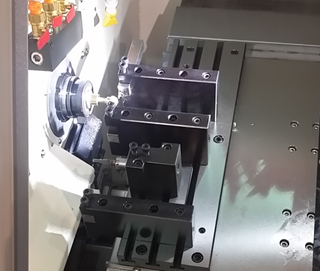
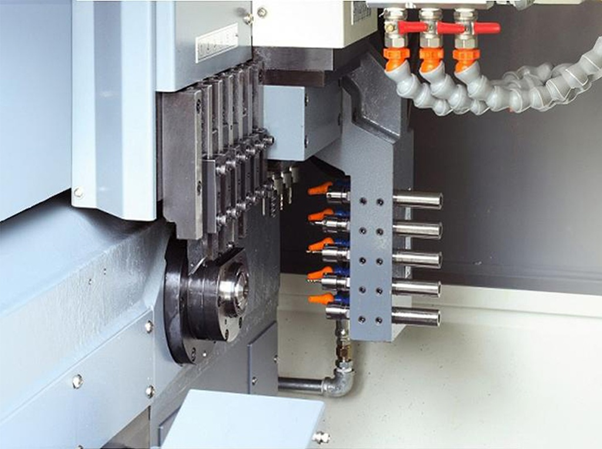
The gang type is a tooling system that installs the cutting tools on a row of a linear slide. It shifts the whole slide to move the cutting tools, allowing them to machine the workpiece. One of the significant advantages of incorporating gang-type tooling systems is that it provides fast tool changing. The tools only displace linearly on the slide, which improves the machining efficiency. The gang type is suitable for machining small and short workpieces, such as components from the electronics industry.
Hybrid type
Some hybrid models incorporate gang-type and turret-type tooling systems in one setup, obtaining the benefits of both types of tooling systems. The operator can switch on different types based on the machining requirements, which offers great versatility to the machining process. When it comes to machining long workpieces, it is suitable to use the turret-type mode. On the other hand, the operator will switch to the gang-type mode while machining small and short workpieces. The hybrid type CNC lathe significantly improves the machining efficiency and versatility.
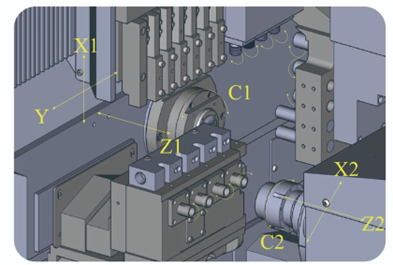
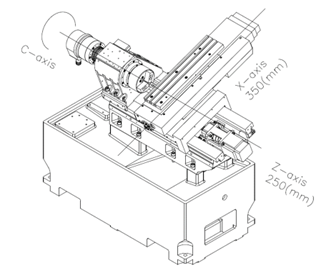
The axis configuration determines how the cutting tools move along and around the workpiece during machining. In CNC lathe machining, multiple-axis configurations typically range from 2-axis to 5-axis systems. Each configuration offers different levels of precision and flexibility.
Basic 2-Axis (X and Z)
The basic 2-axis configuration contains the X and Z-aixs. On the X-axis, the cutting tools perform turning from left to right. As for the Z-axis, the tools perform turning from up to down. This setup is ideal for machining cylindrical parts, providing excellent precision. Moreover, it only requires the control of two axes, delivering a more efficient machining process than multiple-axis machining.
3-Axis (X, Y, and Z)
The cutting tools perform milling and drilling from front to back on the Y-axis. The 3-axis configuration is widely applied in the machining industries. It is commonly used for machining flat surface parts with simple geometry. However, since the axes move in straight, linear paths, 3-axis machining remains limited when handling curved or highly contoured surfaces.
4 or 5-Axis (C Axis and Live Tooling)
The C-axis performs machining operations that rotate around the Z-axis. The CNC lathe can perform operations from different angles, which makes it suitable for machining workpieces with complex geometry. Additionally, the C-axis often pairs with live tooling, which is the powered tool that integrates with the tooling system. It performs drilling and milling to improve the machining efficiency and reduce downtime.
The spindle configuration of the CNC lathe determines how many spindles are used to hold and rotate workpieces during machining. In this section, we will go through different spindle configurations, including single spindle, twin-spindle, and multi-spindle.
Single spindle
The CNC machine that equips a main spindle holds and rotates one workpiece during the machining process. The single spindle setup is ideal for machining small workpieces. It provides excellent rigidity and stability, providing high precision and surface quality. The single-spindle lathes are ideal for machining workpieces that require accuracy, such as automotive and aerospace parts.
Dual-Spindle
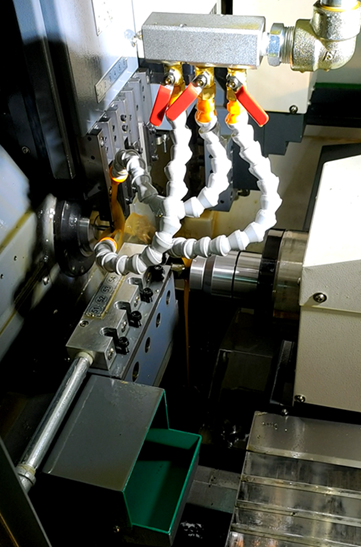
The twin-spindle CNC lathe includes a main spindle and a sub-spindle. The sub-spindle clamps the other side of the workpiece from the main spindle, allowing sequential machining on both ends. This configuration significantly reduces cycle time, eliminating the need for repositioning the workpiece. This setup is widely used for machining electronic housings and mechanical parts.
Multi-Spindle
The multi-spindle CNC lathe features multiple spindles, which can machine the workpiece simultaneously. It performs multiple operations in one workflow, reducing overall machining time and improving production efficiency. Multi-spindle lathes are commonly used in high-volume manufacturing, such as automotive fasteners and fittings.
The Swiss-type CNC lathe is a combination of multiple advanced machining technologies. This innovative lathe integrates a horizontal machine structure, a gang-type tooling system, multi-axis control, and a dual-spindle configuration, offering flexibility and accuracy.
What makes it different from the traditional CNC lathes is the sliding headstock and the guide bushing. The sliding headstock rotates and moves with the workpiece, and the guide bushing provides secure support for the workpiece during the process. This unique design minimizes vibration and deflection, allowing the CNC lathes to handle long and thin workpieces. Due to the superior stability and accuracy, Swiss-type CNC lathes are widely applied in industries that require precise machining, such as medical and aerospace.
As one of the popular machine setups, horizontal CNC lathes contribute significantly to production accuracy and precision in the modern machining industry. By combining automated technology with mechanical stability, it achieves consistent product quality across a wide range of production needs. Understanding its various configurations provides valuable insight into how each setup can be optimized to meet specific machining requirements.
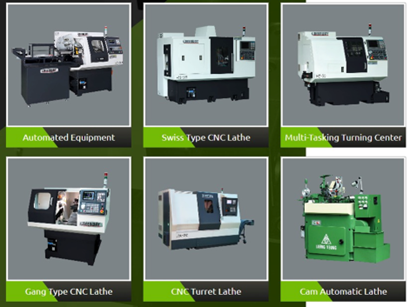
For manufacturers aiming to improve their machining performance, investing in a reliable and high-precision horizontal CNC lathe is essential. GREENWAY offers a comprehensive series of advanced CNC lathes, including the Swiss-type lathe, the multi-tasking turning centers, the gang-type CNC lathe, and the CNC turret lathe. They are engineered for precision, flexibility, and reliability. Contact us for more information on the horizontal CNC lathes and customization options.